Wednesday, March 27, 2013

Weekly Quote Wednesday - Joss Whedon and Sophie Jordan

Weekly Quote Wednesday
Writing quote

“I write to give myself strength. I write to be the characters that I am not. I write to explore all the things I'm afraid of. ”
― Joss Whedon

Historical romance quote

 Convinced he slept, she whispered, "You should have been my first." A small ache pinched her heart.
His chest vibrated beneath her hand, sending a thrilling shiver up her spine as his deep voice rumbled through the air, "I'll be your last.”
― Sophie Jordan, One Night With You

Saturday, March 23, 2013

Night of the Hunter - how to create mood

I thought it might be fun to study a few movies, starring with one of my all time favorites, Night of the Hunter. (One of the greatest movies where Robert Mitchum is a bad guy, and what a bad guy he is.)

I'm going to try not to give too much away, in case you want to view the movie, but I'll give you the IMDB description:

A religious fanatic marries a gullible widow whose young children are reluctant to tell him where their real daddy hid $10,000 he'd stolen in a robbery.


The director, Charles Laughton, is amazing, as are the writers, Davis Grubb and James Agee. They use so many different things to bring across the emotion of each scene, and none are expected. This is a great thing for writers/screenwriters to do. (For example, instead of having a character cry when discovering the death of a loved one, have them laugh, beg, or talk about something important to them or the deceased person.)

Most writers know an important element to conveying emotion is:

Contrast 

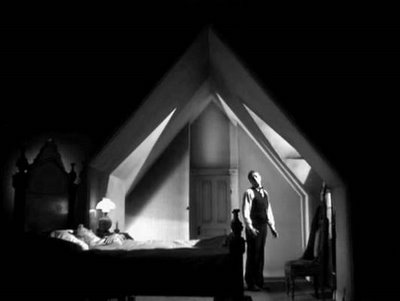
The director's brilliant use of contrasts creates an eerie mood that every writer should appreciate. Contrasts can heighten drama. The use of light and shadow gives the movie a dreary and creepy quality. The director uses unusual angles to give the viewer a sense of things being wrong or unnatural, like the scene pictured above. He also uses the angles and the lighting behind the headboard as a twisted sort of religious imagery.
 
Another scene, features a cobweb in front of the boat holding the two children as they run for their lives. Which is a great example of the movie's:

Symbolism

Instead of the old stand by of a clock or calendar, these men chose a shot of a turtle to show the slow passing of time during their flight. And frightened rabits are used to suggest the children's fear. Probably my favorite symbol would be the preacher's switchblade knife, which pops out of his pocket whenever he feels unwanted desire.

The first half of the movie becomes more and more claustrophobic as use of light and shadow, as well as the size of the house, makes the children's world feel smaller and smaller. This is part of the wonderful:

Sensory detail

The story, while by no means a musical, does have a lot of music in it. The songs convey all we've talked about so far. The little girl sings a song as they run about a fly who flew away, and his wife flew away, and his two pretty children flew away. The symbolism of death and loss is written all over that song, from the words and melody to the scenery (as seen above.)
Then there's the contrast of the scene where the evil preacher sings, "Leaning, leaning," and the good lady sings along, "Lean on Jesus, lean on Jesus, " and then they go on to sing together, "safe and secure from all harm." The creators add little sensory details to capture our attention and make us feel emotions we might not normally feel. They keep us uncomfortable and unsure by their choice of music, ambient sound, interesting shapes and angles as well as suggestive scenes, like the dead woman whose hair waves in the water like the weeds (below). Long scenes pass where little action happens, yet the viewer is never bored because of the eerie details.

From something as obvious as the flaming torches suggesting an evil firebrand preacher, to something as small as how the son's hairstyle denotes his feelings toward his father and the secret he must keep, these little details make up the feeling of each scene and keep the viewer riveted throughout.
As writers we can all take something away from this movie. The details are everything. No matter how small a detail, it can convey meaning to the reader/viewer.

And I'll leave you with the final way this movie can help you enhance your story, with:


Clever and witty quotes

Icey Spoon: (thoughts on sex) When you've been married to a man for forty years you know all that  don't amount to a hill of beans. I've been married to Walt that long and I swear in all that time I just lie there thinkin' about my canning.
 
Ben Harper: What religion do you profess, preacher?
Reverend Powell: The religion the Almighty and me worked out betwixt us.

Rachel Cooper: I'm a strong tree with branches for many birds. I'm good for something in this world and I know it too.

Rachel Cooper: She'll be losing her mind to a tricky mouth and a full moon, and like as not, I'll be saddled with the consequences.

Rachel Cooper: (After watching an owl carry off a rabbit) It's a hard world for the little things.

That last fabulous line is repeated (in homage, I assume) in Raising Arizona--which is a great movie to study for comedic timing.
I hope you enjoyed my study of this movie, and I'd suggest you rent it, if you haven't seen it. It's a great film.


Wednesday, March 20, 2013

Weekly Quote Wednesday - Kurt Vonnegut and Caroline Linden

Weekly Quote Wednesday
Writing quote

"Do not use semicolons . . . All they do is show you've been to college.”
― Kurt Vonnegut, A Man Without a Country

Historical romance quote

 “My intentions . . .” His slow smile acted like a torch held to her skin. She felt prickly with heat and yet transfixed by the glowing allure of it. “I intend to have you, Maggie, in every way a man can have a woman. I want your hand in mine while we dance. I want you laughing beside me in the theater. I want you lying naked in my arms at night. And I want you standing beside me in church, saying ‘I will.’ ”
― Caroline Linden, I Love the Earl

Saturday, March 16, 2013

A Young Man's Fancy - Character Development

It's been a while since I've posted a personal writing post, so I figured now was a good time. I also wanted to discuss what we can learn from the movies, so I'm going to spend a few posts discussing what I've learned from television and movies I've watched recently.

I occasionally watch a show with my husband called Mystery Science Theater 3000 (MST3K). It's a funny show that riffs old movies and shorts (you know, the kind shown in health class.) While watching a short lately (called A Young Man's Fancy) I decided to look up a slang term used by the mother. When I did, I realized there was more to the short than the MST3K episode showed. I'd like to share what this episode taught me about writing characters and how one little action or scene can change your outlook on the characters.


  • The MST3K version
The story is about a young girl, Judy, who is boy crazy. When her brother brings home a college buddy, Alexander Phipps, who is "Serious and studious minded," she isn't interested. But when he shows up with dimples and a strong jaw, all that changes. She's gaga for him. She tries to invite him swimming and uses all her teen wiles to tempt him, but he has a mushroom seminar to attend. Then her mother comes up with the idea Judy should make him dinner, which will, of course, make him fall in love with her and forget all about the seminar.
Judy tricks Alex into coming in to talk to her about electrical devices and time theory while they wait for dinner. After the fine meal, Alex can think of nothing more than going out dancing with Judy.

It's a sweet, though sexist and electrical-device-focused, little love story. Because she likes him so much, when she gets him, we're cheering.

  • The original
When watching the original, there are two short added scenes. Right after she tries to tempt him to swim, there's a scene where she's in the living room with Alex, and she asks him to put on some music. She's ready to dance, but he puts on Beethoven. Our dear Judy is naturally disappointed, and makes a square with her fingers, then sits with a magazine and slaps at the pages, rolling her eyes and saying, "Oh, this is my favorite song."
Alex laughs, then we go to a scene where she's asking her mother if she can go to a dance with another boy because Alex is an intellectual bore. Since Judy has already agreed to go to the mushroom seminar with Alex, her mother says she has to go to the seminar. Then we go to a scene where Judy is visiting a friend and talking about how much of a loser Alex is while they do laundry, and this leads into the scene about her mother having the idea for Judy to make him dinner.

With the new scenes, the feel of the character is entirely changed. Instead of rooting for Judy while Alex talks to her about the electric devices, the audience is imagining her boredom. And at the end, when he chooses to forget the lecture to go dancing with her, it seems less like he is choosing her than that he's just changing the venue. It seems like less of a win, and she seems less worthy of the win. The audience winds up wondering how long the two will stay together, instead of imagining a lasting romance.

  • What this taught me.
A little thing can change a whole story. Even something as small as a word can make a good scene turn ugly. For instance, I recall reading a blog from a historical romance novelist who was talking about a back-list novel she'd put out. Her original story apparently had a forced seduction that was more force than seduction, a common trope for older romances. Since times have changed, she wanted to update the story and alter the rape scene. When she re-released it, readers were complaining that the hero raped the heroine. She couldn't figure out why, until she discovered a single reference toward the end of the book. A friend of the hero censures him for raping the heroine. So the actual love scene, and everything that came after, changed because of the one reference.

If you're interested in watching the MST3K and unedited Jam Handy version, you can find them both with Google. So tell me, has a character ever done something that made you completely change your mind about them?