Showing posts with label Work in Progress Wednesday. Show all posts

Wednesday, April 4, 2012

WIP Wednesday - 18th Century Servant's Clothing


Today I thought I would talk about servant's clothing.

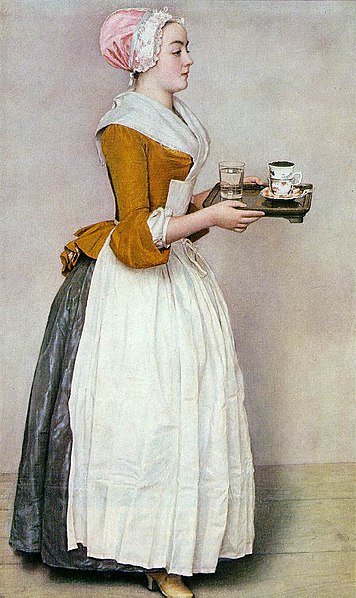
The Chocolate Girl - Jean-Étienne Liotard 1745


This image is a bit before the time I usually
focus on here, but I thought it was a great example of the way servants were expected to dress. Her simple
Caraco and skirt are covered by an apron.
Her hair is covered with a bonnet (mob
cap) which is her only decoration, and
she's wearing a serviceable fichu.
Nothing in her appearance is particularly
ornate.


Henry Robert Morland – late 18th century woman servant


Henry Robert Morland painted a number of images of servants. You can see here that his 18th century servant woman is wearing a fairly plain dress. The bow on her cap is the only decoration. 


Highly visible male servants were the exception. Footmen, the butler, and other highly visible male servants were expected to dress in fancy livery as a show of the estate's wealth.
Colonial Williamsburg

While they were expected to dress well, in accordance with their employer's status, servants who wore clothing considered too ornate or above their station were scorned by the upper classes.  This came to a head toward the end of the 18th century, when the industrial revolution made luxuries more affordable. Soon, servant uniforms began gaining popularity as a mark of the separation of the classes within an estate.
This dichotomy can be seen in this panting, and yo can read more about it, and servants in general here. I also have a link to The Complete Servant (free on google books) under the For Writers tab at the top of the page.

Wednesday, November 30, 2011

WIP Wednesday - Honest writing

For WIP Wednesday, I wanted to talk about writing honestly, no matter how much it bothers you, as the author, to do so. 

In my WIP, the heroine's sister just confessed something she witnessed. I felt a tightening in my gut the whole time I wrote it, then heavily considered removing it for two days after. In the end, I left it in and I'm glad I did. The story would have been paler, and probably more confusing without it.

In The Devil Wears Plaid, by Teresa Medeiros, we learn some pretty terrible stuff about Jamie's past. I have to wonder how different the story would have been if Ms. Medeiros had been to afraid to include it. Jamie's entire past wouldn't exist, a large portion of the motivation for the story wouldn't exist, and the reader would find it far harder to become invested in the story.


Sometimes, as writers, we might want to remove or avoid something that's hard to write. We might tell ourselves that it's not appropriate for the story, or it's not the kind of feelings we want to inspire in our reader, but I suggest thinking on it a few days before hitting delete. 

You might be glad you did. 

Please, feel free to share your favorite book with an indispensable shocking moment.

Wednesday, November 23, 2011

WIP Wednesday - Unusual Duels

Duel au pistolet au XIXème siècle 1857 Bauce et Rouget


During this week, I've been researching duels for a plot line running through my WIP. I found some very interesting tidbits I thought I'd share.

While most duels were fought with sword or gun, some were far more unconventional.


On the 4th of September, 1843, in the commune of Maisonfort, France, two young men named Lenfant and Melfant, quarreled while playing at billiards, and agreed, at last, to settle their disturbance by a duel with billiard balls; after which they drew lots to see which one should get the red ball and throw first. Melfant won the red ball and the first throw, and the two at once took their positions in a garden at a measured distance of twelve paces from each other. Melfant, when the signal was given to throw, made several motions, saying to his adversary, “I am going to kill you at the first throw.” And then he hurled the ivory sphere with deadly aim and effect, for it struck Lenfant in the middle of the forehead and he dropped dead without uttering a word. The survivor was arrested and tried for willful murder, and convicted of manslaughter.

The Field of Honor: Being A Complete and Comprehensive History of Dueling In All Countries; Including the Judicial Duel of Europe, the Private Duel of the Civilized World, and Specific Descriptions of All The Noted Hostile Meetings in Europe and America by Benjamin C. Truman.


And let's not forget the hot air balloons. The staple for any duelist. 
Rama
Two Frenchmen chose to fight from balloons over Paris because they believed they had ‘elevated minds’. Monsieur de Grandpré and Monsieur de Pique quarrelled over a famous opera dancer called Mademoiselle Tirevit, who was mistress of one and lover of the other. So,at 9 a.m. on May 3 1808, watched by a huge crowd, the two Parisians climbed into their aircraft near the Tuileries and rose gently up into the morning air. At about 2,000 ft, when the balloons were about 80 yards apart, de Pique fired his crude blunderbuss and missed. De Grandpréaimed his more effectively. De Pique’s balloon collapsed, the basket tipped, and he and his second fell headfirst to their deaths on the rooftops below. De Grandpré and his second, however, drifted happily away in the light north-westerly breeze before landing safely 20 miles away.

--The Last Duel: A True Story of Death and Honour By James Landale


Dueling was not always this conventional. One man actually threw off some surprising constraints when he dueled. 
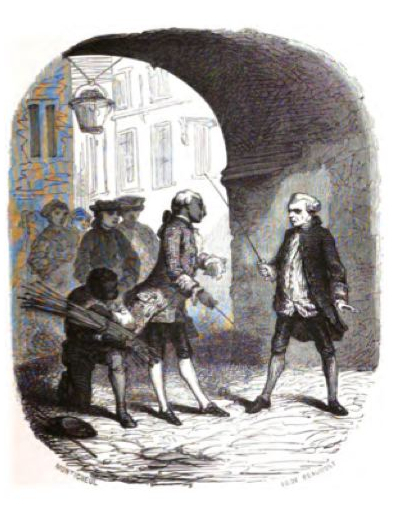
A Member of Parliament once duelled in the nude. Humphrey Howarth, the MP for Evesham, was attending the races at Brighton in 1806 and dined one night at the Castle Inn. There he fell into discussion with the Earl of Barrymore, an Irish peer. Discussion turned into quarrel and they arranged to meet on the race course early next morning. Both men were rogues, and much given to taking the piss. But even Barrymore was astonished as his opponent took his clothes off and presented himself on the duelling ground armed solely with pistol and pants. The seconds and other witnesses burst out laughing, not least because Howarth was by then a fat old man. But Howarth was in earnest. He had spent much of his earlier life as an army surgeon for the East India Company. He knew gunshot wounds were often infected by the dirty clothing that preceded a bullet into flesh. In the end, however, his precaution was redundant. Both he and his opponent missed their targets  and  resolved their dispute without bloodshed.

--The Last Duel: A True Story of Death and Honour By James Landale


There you have it. Truth really is stranger than fiction.
Robin

Wednesday, November 16, 2011

WIP Wednesday - word count checkin

Okay, so here's my wordcount - 44855.
I'm past the halfway point, which is awesome. But I'm doing Nano, and I started at 30k, so I don't think I'm going to make it on time unless I can get my mom to drive 8 hours to take the kids for two days straight. lol. Not likely.
That's all right though. I don't expect to finish. Never did. I have a 1 and 3 year old, and they take up most of my day, so even though I can write 1000 words in an hour, I can't often find an hour without my little ones around. Especially because after bed time, comes hubby time, and we spend most of the two hours before bed hanging out.
The point of my doing Nano was to get me working on the manuscript and hopefully get it finished by the end of December. That I should be able to do. And revisions should be done by mid January. That's the goal, anyhow.
I challenge you to make a goal for yourself that might seem ridiculous, then actually strive for it. The idea is not necessarily reach the goal, but to get as close as possible. Like using the goal of touching the stars to climb Mount Everest.

If you're a writer, good luck with your writing. If your a reader, I hope you enjoyed the blog.
Either way, I thank you for reading, and wish you good luck with your goals.
Robin Delany

Wednesday, November 9, 2011

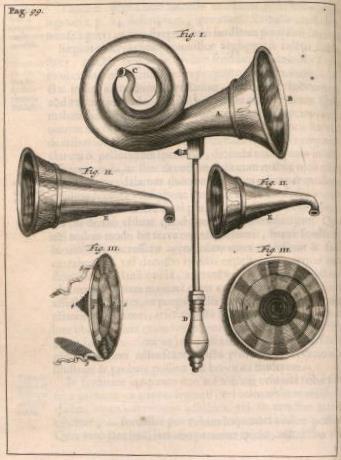
WIP Wednesday - Ear Trumpets The hearing aid of the 18th century

As a writer, we can often find ourselves looking up the most infinitesimal detail at length because we want to include one word in one sentence.

That was me today. My heroine's sister, Rinny, wanted to recall her grandfather's hearing device, so I found myself researching ear trumpets.

I thought I would share a bit of what I found here with you.


There were a number of different styles of ear trumpet going back into the 17th century for the hard of hearing. Most worked on the idea of focusing the sound waves toward the ear drum, like a backward version of the musical instrument they're named for.


It's hard to find many replicas or antiques from before the 19th century, however, but I had to include this picture to give an idea of what they looked like.

Wednesday, November 2, 2011

Work In Progress Wednesday - Archeology

Every Wednesday, I will be posting something about writing my current WIP, a historical romance set in 1785. It might be a writing tip I've got to share, a frustrating bit I'm working on, a fascinating tidbit of research, or perhaps even an excerpt one day. As long as it has to do with my story. In my WIP, the heroine's father is an archeologist.

Did you know, the term archeology didn't come into common use until 1837. (first known use, according to http://www.merriam-webster.com)

However, archeology existed. Here are some of the early archeologists from before archeologists were archeologists. hehe.


Spanish military engineer Rocque Joaquin de Alcubierre

Mr. Alcubierre excavated places like Herculaneum and Pompeii.
"1748: Engineers led by Rocque Joaquin de Alcubierre, working for the King of Naples, dig into the ruins of Pompeii looking for Roman artifacts."
(Digging deeper: Archaeologists race to show Pompeii daily life  By Dan Vergano - USA Today)

William Cunningham (1754­-1810) and Richard Colt-Hoare (1758­-1838)


Sir Richard Colt-Hoare
 Mr. Cunningham and Sir Richard conducted the detailed scientific excavation of a series of barrows near Stonehenge, England, and were known for gentle exploration techniques. They even left plaques during excavation to explain what they'd done to future explorers.
"Sir Richard Colt Hoare who describes Cunnington's methods of excavating as being much more thorough than those of his predecessors dedicated to him the first part of his Ancient History of South Wiltshire on the ground that the existence of the work was mainly due to Cunnington's collections and discoveries From 1804 till his death Cunnington had placed all his materials at Hoare's disposal and made new investigations for the purpose His collection of antiquities was bought by Hoare and is now 111 the museum at Devizes. " (sic) (Dictionary of national biography, Volume 13 edited by Sir Leslie Stephen)

 So, now you've delved a bit into historical archeology. Tell me, do you like archeology and history? (If you're here, you must like it a little. lol ) Do you have any interesting tidbits to share?